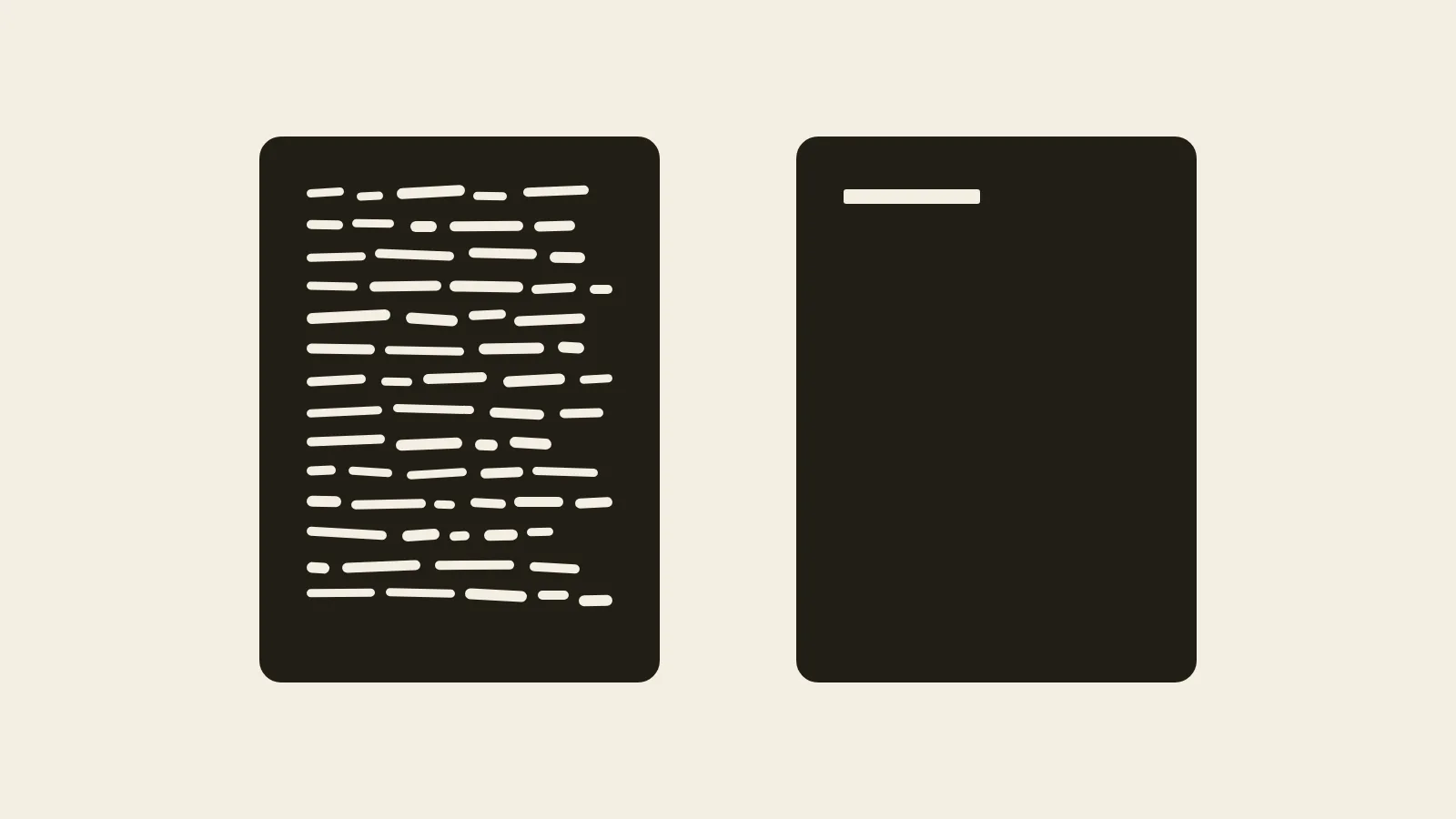
A revision comes back wrong, so you send notes and wait for a second pass. If the notes you sent were your own short version of what the reviewer said, the second pass can miss in the same place, and now you have spent two rounds instead of one.
The fix costs nothing. It is a habit about which words you forward.
Summarise for yourself. Send the worker the original.
What a summary is for
Summaries are good. You need one. When a reviewer sends back a page of comments, the first thing you do is boil it down so you know what you are dealing with: three changes, one of them big, and a question about the deadline. That short version is how you plan, decide what to push back on, and judge how long it will take.
The trouble starts when that same short version gets handed on to the person or the tool doing the edits. A summary is written for the person making decisions. It keeps the gist and drops the texture, because the texture does not matter for planning.
For the one doing the work, the texture is often the whole job.
What gets lost in the paraphrase
When you rewrite someone's feedback in your own words, a few things go missing, and they tend to be the same few things every time.
- The exact word they used. "Make the heading quieter" and "make the heading smaller" are not the same request. One might mean lighter weight or a softer colour. The other means size. Your paraphrase picks one reading and hides the fact that there was a choice.
- The example they pointed at. Reviewers often say "like the one on page two" or "the way the old version did it". In a summary that becomes "match the style", and the reference that made it specific is gone.
- What they did not say. If a reviewer comments on the colour and says nothing about the layout, that silence is information. A tidy summary of "a few tweaks to the design" erases the line between what was flagged and what was left alone.
- The order and the emphasis. People tend to lead with what bothers them most and mention small things in passing. A bulleted summary flattens all of it to the same weight.
- Their tone. "This is close" and "this is not working" call for very different second passes. Paraphrase sands the tone off.
None of these is a big loss on its own. Together they are the difference between a revision that lands and one that is technically responsive but somehow still wrong.
Why this matters more when the worker is an AI
A person doing the edits will often ask a question when your summary is vague. They might say "smaller or lighter?" and you go back to the source. That question is a safety net, and it only works because a person notices when something is ambiguous.
An AI tool usually does not ask. It takes the words you gave it and does its best with them. If your summary says "make it feel more premium", it will make something feel more premium by its own idea of what that means. The reviewer's actual words, maybe "too many colours, and the logo is fighting the photo", would have pointed it at two specific fixes. Your summary pointed it at a mood.
So the cost of a lossy handoff is higher with an AI, not lower. You lose the detail and you lose the question that would have recovered it.
The good news runs the other way too. An AI does not get tired of reading a long page of comments. A person might quietly wish you had shortened it. A model will read every line with the same attention. Raw feedback is the kind of input it is good with.
Where your own words still belong
This is not an argument for forwarding feedback and stepping back. You still have work to do, and it goes around the original, not in place of it.
- Above it, add the decisions. If you have decided not to make one of the requested changes, say so plainly. "Ignore the point about the font, we are keeping it." That is a call only you can make.
- Add context the reviewer assumed. They may refer to a conversation the worker never saw. One line of background fills that gap.
- Below it, say what done looks like. "Send back the revised file and a short list of what changed." This is about the handoff, not the content.
Your words frame the original. They do not replace it.
A worked example
Here is the same round of notes, relayed two ways. The changes are invented for illustration, but the pattern is the common one.
| What the reviewer wrote | Summary that gets relayed | What the summary loses |
|---|---|---|
| "The heading is shouting. Can it sit back a bit, like the subheads on the second page?" | "Make the heading smaller." | The reference to the second page, and the hint that weight or colour might be the fix, not size. |
| "Love the photo. The text over it is hard to read on my phone." | "Fix text legibility." | That the photo stays, and that the problem shows up on a small screen. |
| "Not sure about the green. Maybe it is fine, see what you think." | "Change the green." | That this was a soft maybe, not a request. |
The summary in the middle column is fair, and nothing in it is wrong. It is a reasonable note for your own to-do list. But a worker who gets only that column will make the heading smaller, change the green, and adjust the text in some way that may or may not help on a phone. A worker who gets the left column has what they need to get it right the first time.
This came up in a real round of revisions. Pasting the reviewer's comments word for word to the AI making the edits, rather than restating them, was the pass that hit. One case proves nothing on its own, but the reason it worked is the one above: the details the revision depended on were in the original and nowhere else.
A simple way to do it
When feedback arrives and someone else, or something else, is doing the edits:
- Read the original and write your own short summary, for you.
- Make your decisions: what to do, what to skip, what to push back on.
- Send the worker the original, word for word, with your decisions written above it and what done looks like written below.
If the feedback came by voice or in a meeting, write down what was said as closely as you can before you summarise it. A rough transcript is still closer to the source than a cleaned-up note.
What to take away
- Summarise for yourself, to plan and decide. Do not hand that summary to the one doing the work.
- Forward the reviewer's own words, in full, with your decisions and any missing context added around them.
- Be most careful when the worker is an AI, because it will not ask what you meant. It will guess.
Relaying feedback well is mostly a matter of not standing between the reviewer and the worker. Your job is the decisions around the notes: what to keep, what to drop, and when it is done. The AI does the busywork. You still make the calls.