You still make the calls.
A plain-English guide to how AI systems actually work. No pitch, only the concepts, so you can walk into any conversation about AI (including one with us) knowing what you’re being offered.

Everyone is trying to sell you “AI.” This won’t.
Half the pitches don’t even agree on what the word means, let alone whether you need it. That makes it almost impossible to tell a genuinely useful tool from a subscription that’ll sit unused by March. This guide does the thing most vendors skip: it explains the actual concepts, in plain language.
By the end, you’ll be able to:
- Tell the difference between AI, automation, and an “agent,” and know why it matters
- Recognize the levels of automation, from simple rules to autonomous agents, and know which fits a task
- Spot real, useful applications of AI for a business like yours
- Ask the right questions before you adopt any AI tool, from anyone
What is the difference between AI, automation, and an agent?

Vendors throw around “AI,” “automation,” and “agent” like they’re interchangeable. They’re not, and knowing the difference is the single most useful thing this guide can give you.
Automation is the oldest of the three: a set of fixed rules. If this happens, do that. An email that goes out when someone books an appointment is automation. It’s predictable, cheap, and it never gets creative, which is usually exactly what you want.
AI is broader. It’s software that can handle tasks that used to require human judgment: reading a message and understanding it, summarizing a document, drafting a response that sounds like a person wrote it. AI is the ingredient, not a system that does anything by itself.
An agent is where those combine: AI given a goal, some tools, and the ability to take multiple steps on its own, checking things, making small decisions, adjusting as it goes. Something that answers “what are your hours” is AI. A system that notices a request has stalled, checks the record, chases the missing piece, and escalates to a person if nothing arrives by Thursday. That’s an agent.
Most of what gets marketed as “AI” is automation with a new coat of paint. That is not necessarily bad. Automation is often exactly what you need. It is worth knowing which one you are paying for.
What are the four levels of automation?

Not every task deserves the same level of software. The mistake most businesses make isn’t using too little AI. It’s mismatching the level to the task.
Simple rules
"If a request comes in after hours, acknowledge it and queue it for the morning." No AI involved, no judgment required. The most reliable, cheapest, and most boring layer, and for a large share of the work that clogs an operation, boring is exactly right.
AI-assisted, human-approved
AI drafts something; a person reviews it before it goes anywhere. The AI saves time on the first draft; a person still makes the final call. This is the safest way to start using AI, and often the right permanent home for anything customer-facing.
Agentic, with checkpoints
The system handles a multi-step process on its own, but stops and asks for a decision at defined points, like an unusual request or a price above a threshold. This is where the real time savings show up, but only if the checkpoints are designed well.
Fully autonomous
The system acts entirely on its own, with no human review, ever. For almost any process with a real cost attached, this is the wrong place to be. The cost of one mistake usually outweighs the time saved. Be skeptical of anyone pushing you straight to Level 4.
The meter shows how much runs without you. More green isn’t better. It’s only right when the task can afford a mistake.
Which level does your task belong at?
Three questions. The answer is a level and the reasoning behind it, worked out the same way I would work it out on a call. Nothing is sent anywhere until you choose to send it.
Answer the three questions to see which level fits.
Where does AI actually help in a business?
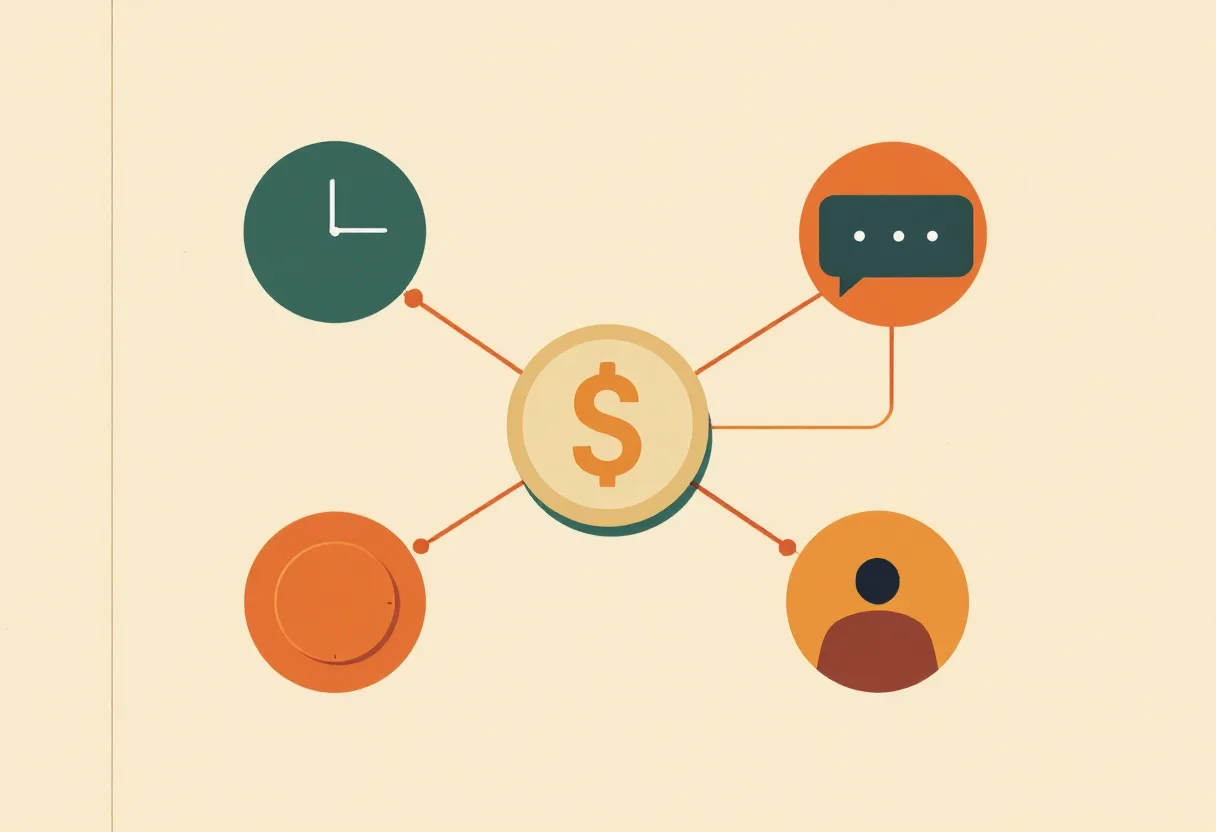
Customer communication
Acknowledgements, status updates, and answers to questions you have already answered a hundred times can run almost entirely on their own. Anything carrying judgment, a complaint, an exception, a first conversation, should route to a person.
Back office
Intake, records, reporting, and reconciliation are the biggest hidden time sink, mostly because they live in three systems that don’t talk to each other. Connecting them is often the highest-leverage use of AI, and the least glamorous.
Marketing
AI is genuinely good at first drafts: a social post, a newsletter, a product description. It is not good at your brand voice without guidance, and it should never be the last set of eyes before something goes out under your name.
Decision support
The most underused category. AI can pull together the information you need to make a call (past history, current inventory, what a similar situation cost last time) without making the call itself. A lot of the real value sits here.
What should you ask before buying an AI tool?
This list works regardless of who you’re evaluating, us included.
What exactly does this automate, and what does it leave to me?
If the answer is vague, that’s the answer.
Can I see what it did and why, after the fact?
A tool with no visible log is a black box, and black boxes fail quietly.
What happens when it’s wrong?
Every system is wrong sometimes. The question is whether a mistake gets caught before it reaches a customer, or after.
Does this connect to what I already use?
A tool that doesn’t talk to your systems of record is solving a much smaller problem than it looks like.
Do I actually need this to be "smart," or would a simple rule do the same job?
Not every problem needs AI. Some just need a reminder to go out on time.
Why do most AI projects fail?
Almost every business that gets frustrated with AI made the same mistake: they bolted it on instead of building it in. A tool bought on a demo and pointed at a problem it has no context for. Something running alongside the business instead of inside it, added on top rather than built to understand how the work actually moves.
The businesses that get real value do the opposite. They start by mapping what’s actually repetitive versus what actually needs a person, and they build systems that reflect that map, connected to what they already use, with checkpoints in the right places.
That’s a harder thing to sell in a single ad, which is probably why so few vendors lead with it.
Where this comes from
RF Digital was built on that idea. I spent years designing how people supervise AI agents inside large-scale data systems, where a wrong call is expensive. This guide, and the way I approach every project, comes from that work: what a system can settle on its own, what it has to escalate, and what a person needs in front of them the moment it does.