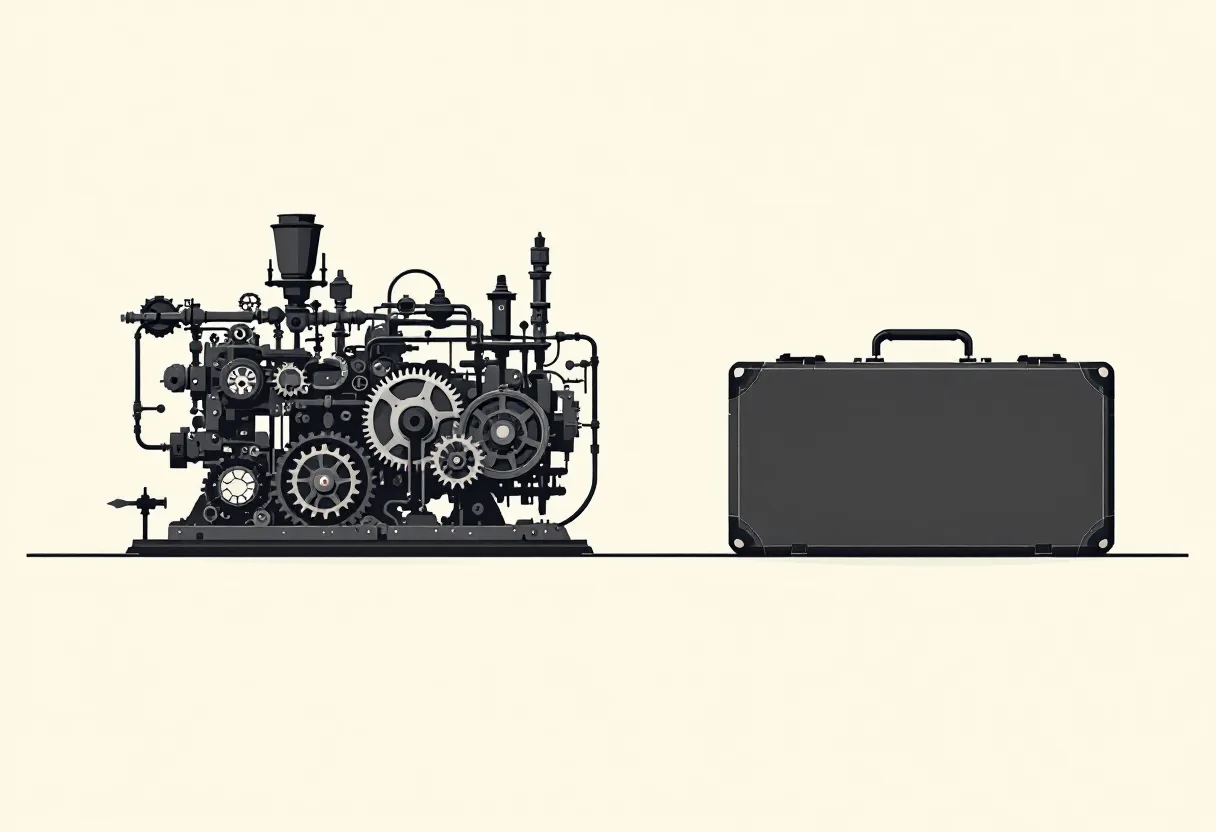
There is a specific moment in any pilot that feels like the finish line and is not. The thing runs. The output is good. You can show someone.
And if a buyer asked what they would be purchasing, you would not have a clean answer.
Proof answers "can this work". An offer answers "what do I get, what does it cost, and what is different on Monday". Those are two different projects.
Why the finish line moves
A pilot is built to remove technical doubt, so it is scoped to the hardest question. Can the model handle this material. Does it run on hardware we control. Is the output good enough to trust.
Those are excellent questions and answering them takes real work. The trouble is that answering them produces a demonstration, and a demonstration is addressed to you. It settles your uncertainty. It does not tell anyone else what they are buying.
The buyer's questions are almost entirely different ones. What exactly do I receive. Who sets it up. What happens when it breaks. What do I stop doing once this exists. What does it cost, and against what.
None of that gets answered by a working pilot, because none of it is a technical question. It is a product question, and product questions are the second half of the job, not a formality after the first half.
The four things an offer has to say
A pilot becomes an offer when a stranger can read it and know what happens next. In practice that takes four statements, in plain words:
| Statement | The failed version | The version that works |
|---|---|---|
| What you get | "An AI system for your documents" | "Intake files summarized into your record system, same day" |
| Where it runs | "Secure and private" | "On a machine in your office, nothing leaves the building" |
| What it costs | "Depends on scope" | "A fixed setup fee, then a flat monthly amount" |
| What changes | "Big efficiency gains" | "Nobody retypes an intake form again" |
The left column is not dishonest. It is what you genuinely know at the end of a pilot, and it is why the pilot feels finished when it is not. Every entry on the right is a decision somebody has to make, and the technology does not make any of them for you.
The trap of building more
The natural response to an unclear offer is to strengthen the proof. Add another capability. Handle another file type. Push the accuracy higher.
That instinct is comfortable because it is the same kind of work that succeeded before. It is also usually the wrong move, because the thing blocking a sale is not doubt about capability. It is that nobody can tell what they would be agreeing to.
More capability makes that worse, not better. A system that does nine things is harder to describe than one that does one thing, and "it can do almost anything" is the least persuasive sentence in the language.
The shortest way through
Write the offer before you finish the build. Not a pitch deck: four sentences, in the shape above, that a person outside the work could read and understand.
Then check them against the pilot you have. Usually one of two things happens. Either the sentences are easy to write, in which case the pilot was scoped well and you are closer than you thought. Or one sentence will not come, and that is the actual open question. It is nearly always the last two: what it costs, and what a person stops doing.
That is a much cheaper thing to discover on a page than after another month of building.
What to take away
- Treat proof and offer as two separate pieces of work. Finishing the first does not start the second, and only the second is something anyone can buy.
- Write the four sentences early. What they get, where it runs, what it costs, what changes. The one that will not write itself is your real open question.
- When the offer is unclear, resist adding capability. More surface makes the thing harder to describe, and description is the thing that is missing.
The AI does the busywork. You still make the calls.